

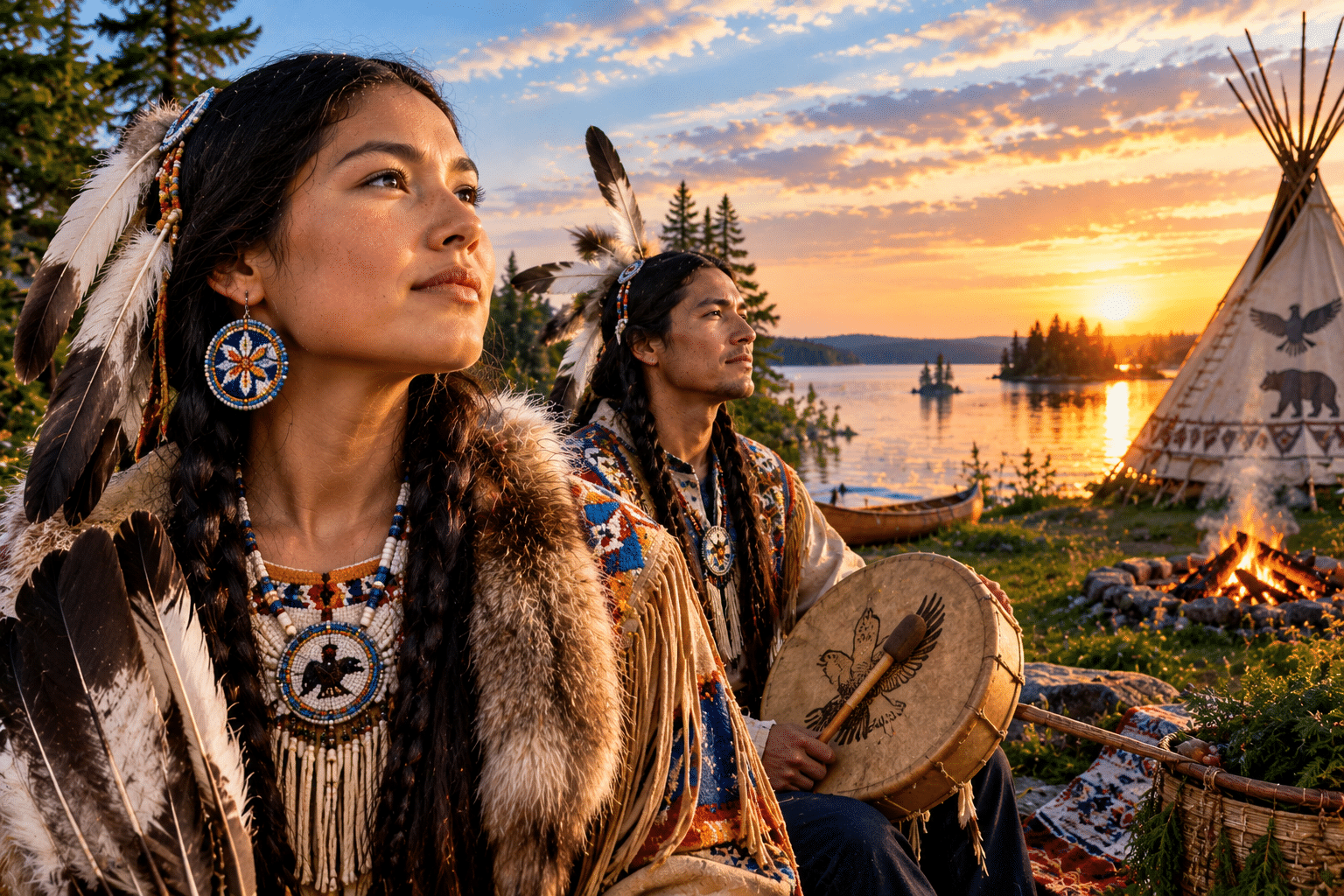
Some cultures teach us about the importance of belonging in ways that stay with us long after we have finished learning about them. The Ojibwe and Cree peoples of North America offer exactly this kind of perspective. Their histories are connected to vast forests, lakes, rivers, grasslands, and northern landscapes, but their stories reach far beyond geography. They are stories of language, family, community responsibility, traditional knowledge, and the determination to maintain cultural identity through generations of change.
What makes these peoples especially fascinating is that their heritage is not confined to the past. Ojibwe and Cree communities continue to raise families, create art, protect their languages, practise traditions, and shape their futures. For Tribal World, exploring their lives means looking beyond historical summaries to understand the people, values, and experiences that keep their cultures alive today.
The Ojibwe: A People Connected to the Land and Water
The Ojibwe, also known as Anishinaabe or Chippewa in different contexts, are an Indigenous people whose ancestral territories extend across parts of the Great Lakes region of Canada and the United States. Their communities have longstanding connections to areas around Lake Superior, Lake Huron, and other lakes, rivers, and forested regions.
The name Anishinaabe is used by many Ojibwe people as part of their identity, although terminology and preferences differ among communities. This diversity is worth recognising because Indigenous peoples are not defined by a single name or a uniform experience.
For generations, Ojibwe communities developed extensive knowledge of their environments. Fishing, hunting, gathering, cultivation, and trade all played important roles in different places and periods. Their knowledge of seasonal cycles helped people understand when particular resources were available and how to use them responsibly.
One particularly significant cultural and ecological connection is manoomin, commonly known as wild rice. Wild rice has long held importance for many Ojibwe communities around the Great Lakes. It is valued as food and carries cultural and spiritual significance connected to history, identity, and relationships with the land.
This connection reminds us that food can mean much more than nourishment. A traditional ingredient may carry memories of family gatherings, knowledge of local ecosystems, and teachings about the responsibilities people have toward their surroundings.
Ojibwe communities are diverse, and their contemporary lives include rural and urban settings, modern professions, cultural organisations, and many different personal experiences. Their traditions continue not because their world has remained unchanged, but because people continue to find meaning in their heritage.
The Cree: A Wide-Ranging Indigenous Heritage
The Cree peoples have one of the most extensive Indigenous cultural and linguistic distributions in Canada, with communities also found in parts of the United States. Their territories include regions of the Prairie provinces, the boreal forest, northern Ontario and Quebec, and areas around James Bay and Hudson Bay.
There is no single Cree lifestyle that represents everyone. Historical and contemporary experiences differ between communities, including Plains Cree, Woods Cree, Swampy Cree, and other regional and linguistic groups.
In some areas, hunting, fishing, trapping, and gathering have played important roles in community life. Other communities have developed traditions closely connected to coastal environments, river systems, or grassland landscapes. Trade and relationships with neighbouring Indigenous peoples have also shaped Cree history over many generations.
The Cree languages belong to the Algonquian language family and include several regional varieties. Their wide geographical distribution reflects the longstanding presence of Cree-speaking communities across a remarkable range of environments.
What stands out about Cree heritage is the relationship between cultural knowledge and adaptability. Communities have developed ways of living in different landscapes, responding to seasonal conditions, and maintaining relationships across extensive territories.
Their history also includes profound disruption caused by colonial expansion, land dispossession, and government policies that interfered with Indigenous family and community life. Nevertheless, Cree peoples have continued to assert their identities, protect their rights, and strengthen their cultural traditions.
Their story is not simply one of survival against hardship. It is also a story of knowledge, creativity, leadership, and the determination to shape the future on their own terms.
Language: The Voice of a Living Heritage
One of the most important connections between the Ojibwe and Cree peoples is the significance of their Indigenous languages. Ojibwe languages and dialects belong to the Algonquian family, as do Cree languages, although they are distinct linguistic traditions with their own vocabulary, pronunciation, and regional variations.
A language carries more than the ability to exchange information. It contains familiar expressions, humour, ways of describing the natural world, and forms of knowledge that develop within a community over generations.
Think about the words that families use to comfort children, tease relatives, or describe a place they have known throughout their lives. These expressions can carry feelings and associations that are difficult to reproduce in another language.
For Ojibwe and Cree speakers, their languages can provide direct connections to ancestral teachings, oral histories, place names, and cultural understandings.
Colonial education policies and the suppression of Indigenous languages contributed to language loss in many communities. Some children were separated from their families and placed in residential schools, where Indigenous languages and cultural practices were often prohibited or discouraged.
The consequences have extended across generations, affecting family relationships and opportunities to pass on cultural knowledge.
Today, Indigenous educators, elders, language speakers, and community organisations are working to strengthen language learning through immersion programmes, classes, recordings, books, and digital resources. Some Cree communities also use syllabic writing systems, while others use alphabetic orthographies.
These efforts demonstrate that revitalisation is both practical and deeply personal. Learning a language can help reconnect families with knowledge that earlier generations were prevented from sharing.
A language becomes stronger when children can use it naturally, adults can speak it in everyday settings, and communities have the resources to ensure it remains part of contemporary life.
Storytelling: Knowledge Shared Between Generations
For many Ojibwe and Cree communities, oral traditions have long been important ways of sharing history, teachings, and collective memory.
Stories can explain relationships between people and the natural world, communicate moral lessons, preserve historical experiences, and help younger generations understand their responsibilities within the community.
Among Ojibwe traditions, stories associated with Nanabozho, also known in some contexts as Wenabozho, occupy an important place in many communities. The figure and the stories associated with him vary across traditions and should not be reduced to one universal interpretation.
Cree communities also maintain rich oral traditions, including narratives connected to ancestral experiences, animals, relationships, and the natural world. The specific stories and their meanings differ across communities.
What makes oral tradition so valuable is that storytelling involves a relationship between the person sharing knowledge and the people receiving it. Tone, timing, humour, and the circumstances of a gathering can all influence how a story is understood.
Listening becomes an act of participation. Younger people learn not only through the words themselves, but also by observing how stories are shared and when particular teachings are considered appropriate.
These traditions deserve respect because some knowledge is intended for particular audiences or occasions. Appreciating Indigenous storytelling does not mean assuming that every story should be reproduced without permission or separated from its cultural context.
Sometimes, the best way to respect a tradition is to listen carefully and recognise that not all knowledge is ours to claim.
Family, Community, and Shared Responsibility
Family relationships are important in many Ojibwe and Cree communities, although family structures, customs, and responsibilities differ across regions and individuals.
Extended family networks can provide support with raising children, caring for elders, organising gatherings, and maintaining cultural traditions. Grandparents, aunties, uncles, and other relatives may play important roles in teaching younger family members about language, history, and community values.
These relationships also help preserve knowledge that cannot always be learned through formal education. A child might learn about local plants by accompanying a relative outdoors, discover a traditional recipe through helping prepare a meal, or develop an understanding of family history by listening to an elder’s memories.
Such experiences connect cultural learning with everyday life.
Of course, contemporary Indigenous families face many of the same pressures experienced by families elsewhere, including employment demands, housing challenges, geographical distance, and the competing responsibilities of modern life.
Maintaining traditions therefore requires time and opportunity. Cultural knowledge is easier to pass on when generations can spend time together and when communities have access to places where traditional activities can continue.
This is one reason community-led cultural programmes are so valuable. They create spaces where younger people can learn from experienced knowledge holders while building relationships with others who share their heritage.
Art, Craftsmanship, and Cultural Expression
Ojibwe and Cree artistic traditions reflect considerable creativity and regional diversity. Beadwork, quillwork, textile arts, carving, clothing, and other forms of craftsmanship have served practical, aesthetic, and cultural purposes across different communities.
Ojibwe floral beadwork, for example, is widely recognised for its intricate arrangements of flowers, leaves, and other natural forms. The styles vary, and individual artists often bring their own interpretations to established techniques.
Cree artists likewise contribute to a rich range of artistic practices, including beadwork, clothing decoration, carving, visual art, and contemporary creative work.
These traditions demonstrate that craftsmanship is not simply about producing attractive objects. It involves learning techniques, understanding materials, developing patience, and making creative decisions.
Traditional arts can also provide opportunities for contemporary expression. Indigenous designers, painters, writers, and musicians continue to explore their identities through modern forms while drawing inspiration from community histories and inherited knowledge.
Supporting Indigenous artists means recognising their work as a genuine contribution to the wider cultural world. It also means respecting ownership, acknowledging artistic origins, and ensuring that cultural designs are not copied or commercialised without appropriate permission.
Land Rights and the Challenge of Protecting Ancestral Relationships
For both the Ojibwe and Cree peoples, relationships with ancestral territories remain important in contemporary discussions about rights, environmental protection, and community well-being.
Colonial governments established laws and policies that restricted Indigenous access to land and interfered with traditional governance. Treaties, land agreements, and their interpretation continue to influence relationships between Indigenous nations, governments, and other land users.
Many Ojibwe and Cree communities are actively involved in protecting waterways, forests, wildlife, and culturally significant places. Their concerns may include industrial development, pollution, resource extraction, habitat changes, and the protection of traditional harvesting practices.
These issues cannot be understood simply as disagreements over land use. For Indigenous communities, territories can support food systems, cultural activities, family memories, and the transmission of traditional knowledge.
When a lake becomes polluted or access to a traditional harvesting area is restricted, the consequences can extend beyond the immediate environmental damage. They may also affect the opportunities available to younger generations to learn the practices of their ancestors.
Indigenous environmental knowledge can contribute valuable perspectives to conservation and resource management, particularly when it is considered alongside scientific research and community experience.
However, meaningful participation requires more than asking Indigenous people to share their knowledge. It also involves respecting their rights, listening to their concerns, and recognising their authority in decisions affecting their territories.
Cultural Renewal and the Future
The Ojibwe and Cree peoples continue to strengthen their cultures through language revitalisation, education, artistic expression, community leadership, and the transmission of knowledge between generations.
Young Indigenous people are increasingly finding ways to connect their heritage with contemporary interests. They may create digital language resources, produce films, perform music, study traditional ecological knowledge, or pursue careers that support their communities.
These activities show that cultural identity is not opposed to modern life. A person can embrace new technology while learning an ancestral language. A community can establish contemporary institutions while maintaining traditional practices. And artists can develop original work without losing their connection to inherited cultural knowledge.
The future of these communities will not look identical to their past, nor should it have to. Each generation deserves the opportunity to decide how its heritage will be expressed and what knowledge it wants to carry forward.
The important thing is to ensure that cultural renewal is supported by the people themselves and that the resources needed for language, education, and community life remain accessible.
A Heritage That Continues to Grow
The Ojibwe and Cree peoples remind us that Indigenous cultures are not distant fragments of history. They are living communities with distinct languages, deep relationships with their homelands, rich artistic traditions, and a continuing role in shaping the future of North America.
Their stories reveal the value of knowledge passed between generations, the importance of protecting ancestral territories, and the strength that can come from maintaining a meaningful connection to one’s identity.
For Tribal World, celebrating these peoples means recognising both their shared experiences and their differences. It means appreciating their traditions without treating their cultures as interchangeable, and learning about their histories without overlooking their contemporary achievements.
Perhaps the most powerful lesson is that heritage survives through relationships: between grandparents and grandchildren, between language and memory, and between communities and the lands that have sustained them.
The Ojibwe and Cree stories remind us that cultural strength is not measured by how little a people changes. It is measured by their ability to carry their knowledge, identity, and values forward while shaping a future that remains their own.