

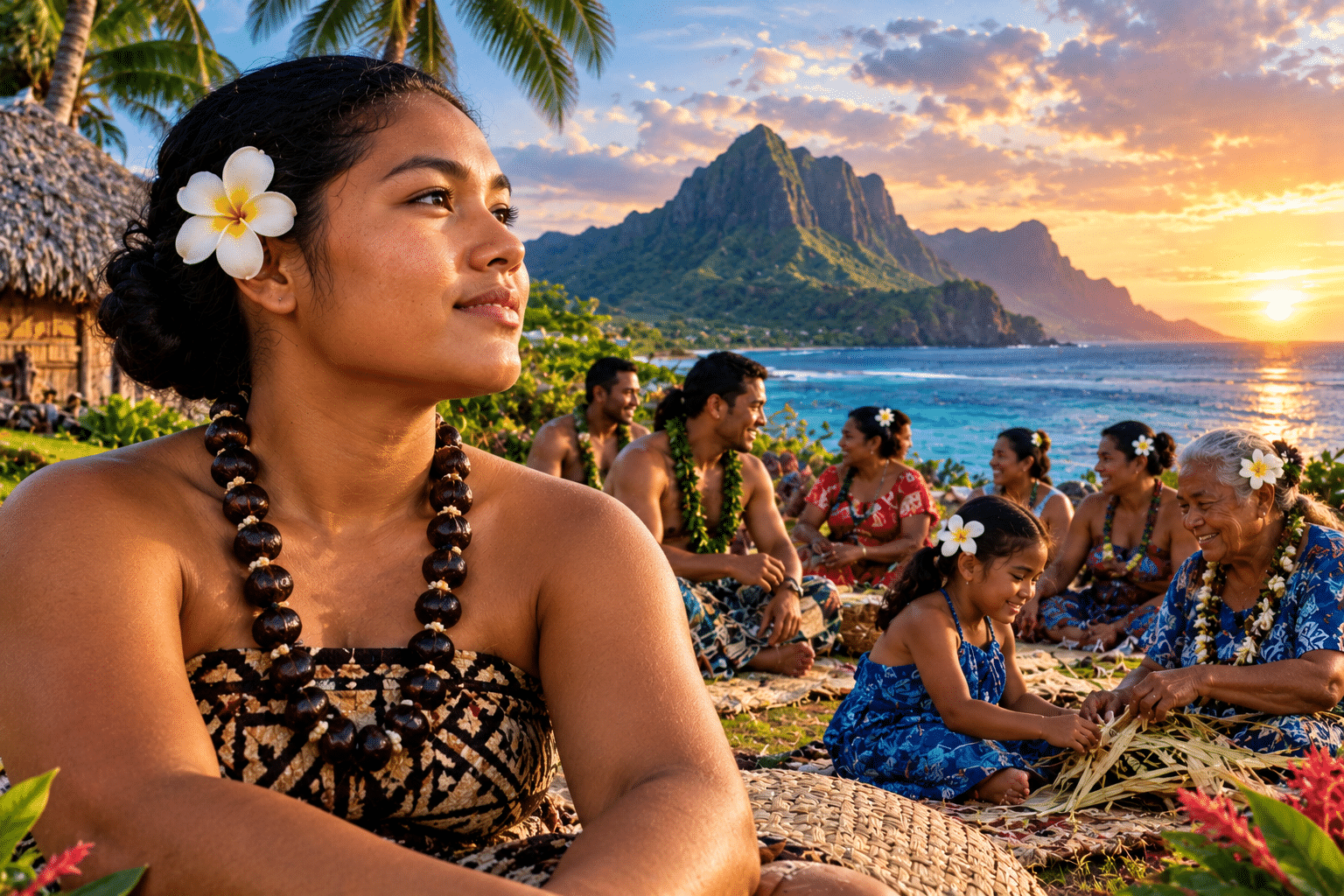
There is something deeply moving about a culture that teaches people to understand themselves not only as individuals, but as part of something larger. Among the Samoan peoples of the South Pacific, this understanding can be found in family relationships, community responsibilities, traditional ceremonies, storytelling, and a profound sense of belonging. Samoan culture is often associated with beautiful islands, warm hospitality, and vibrant celebrations, but its true richness goes much deeper. It lives in the everyday choices people make to care for one another, honour their elders, remember their ancestors, and pass their knowledge to the next generation.
For Tribal World, the Samoan story is an opportunity to discover a culture in which identity is not simply inherited. It is practised, nurtured, and strengthened through the relationships that shape everyday life.
A Homeland Shaped by the Ocean
Samoa lies in Polynesia, in the heart of the South Pacific. Its independent island nation consists of two principal islands, Upolu and Savaiʻi, along with smaller islands. American Samoa, a separate United States territory, is also home to Samoan communities with closely connected cultural roots. Together with Samoan communities living throughout the world, these islands form part of a wider cultural landscape linked by language, family, history, and the ocean.
The sea has always been more than a geographical feature in Polynesian life. It has connected communities, supported livelihoods, and provided pathways for movement between islands. The wider Polynesian world was shaped by extraordinary voyaging traditions, supported by sophisticated knowledge of winds, currents, stars, and changing weather conditions.
For Samoan communities, the natural environment also influences food, work, celebrations, and the rhythms of village life. Tropical vegetation, coastal waters, and fertile land provide important resources, while the ocean remains central to the identity of an island nation.
What I find especially interesting is how geography can shape more than practical habits. It can influence the way people understand belonging. An island may have clear physical boundaries, but the relationships between its people can extend far beyond its shores.
Today, Samoan families live across New Zealand, Australia, the United States, and other parts of the world. Migration has created communities that maintain connections with their ancestral homeland while building lives in different countries. These connections show that cultural identity does not disappear simply because someone moves away. Sometimes, distance makes the desire to preserve language, family traditions, and cultural knowledge even stronger.
Faʻa Samoa: Understanding the Samoan Way of Life
At the heart of Samoan culture is the concept of faʻa Samoa, commonly translated as the Samoan way of life. It encompasses values, customs, social responsibilities, and patterns of behaviour that have shaped Samoan communities across generations.
Rather than describing one isolated tradition, faʻa Samoa offers a way to understand how different aspects of life fit together. Family relationships, respect, service, hospitality, faith, and community participation can all play important roles, although individual experiences and interpretations naturally vary.
One of its most significant principles is the understanding that personal life is connected to collective well-being. Decisions may be considered in relation to family responsibilities, community expectations, and the needs of others.
This does not mean that every Samoan person lives in exactly the same way or that individual ambitions are unimportant. Contemporary Samoans have diverse experiences, beliefs, and priorities. Rather, faʻa Samoa provides a cultural framework through which many people understand their responsibilities and relationships.
There is something valuable in this perspective. Modern life often encourages us to measure achievement individually, focusing on personal success and independence. Samoan cultural values invite us to consider another dimension of success: how we contribute to the lives of those around us.
Sometimes, the most meaningful contribution is not a public accomplishment. It is showing up for a relative, helping a neighbour, supporting a community event, or making sure an older family member is cared for.
These actions may seem ordinary, but repeated over time, they help create a strong sense of belonging.
Aiga: The Strength of Family and Community
The Samoan concept of aiga, meaning family or extended family, is central to understanding Samoan social life. It can include parents, children, grandparents, relatives, and wider networks of kinship whose relationships extend across households and generations.
In many Samoan families, responsibility is not limited to the immediate household. Relatives may support one another with childcare, education, practical assistance, important celebrations, and the challenges that come with everyday life.
Family gatherings can become occasions for sharing food, exchanging news, discussing responsibilities, and strengthening relationships. Important life events are often experienced collectively, with relatives contributing their time, resources, and support.
This sense of shared responsibility can be particularly meaningful when families face difficulties. A person does not always have to navigate hardship alone because support may be available through a wider network of relatives and community members.
Of course, family expectations can also bring obligations and pressures, and experiences differ between households. Understanding aiga honestly means recognising both its strength as a source of support and the responsibilities that come with belonging to a close-knit family.
What stands out is the idea that relationships require participation. Family is not simply a label; it is something people maintain through care, communication, and practical acts of support.
In a world where many people struggle with loneliness despite being constantly connected online, this offers an important reflection. Meaningful relationships grow when people make time for one another and accept that caring for a community involves more than words.
Matai: Leadership Rooted in Responsibility
Traditional Samoan society includes the matai system, a system of chiefly titles and family leadership that remains significant in many communities.
Matai titles are connected to extended family structures, known as aiga, and carry responsibilities involving family affairs, customary land, representation, and community matters. The system is closely associated with the fa’amatai, the traditional framework through which matai leadership and customary responsibilities operate.
A matai’s role is not simply a marker of prestige. It involves service, consultation, decision-making, and the responsibility to consider the interests of the family and, in many circumstances, the wider village.
Samoan governance has its own historical complexity, and customary leadership operates alongside contemporary political, legal, and social institutions. The details of leadership and participation can differ between communities.
Still, the emphasis on responsibility offers a worthwhile point of reflection. Leadership is often discussed in terms of authority, visibility, or influence. The Samoan tradition encourages us to consider the obligations that accompany those qualities.
What does a leader owe the people they represent? How should decisions balance individual interests with collective needs? And how can authority be exercised in a way that strengthens rather than weakens relationships?
These questions are relevant far beyond the Pacific. They remind us that leadership becomes meaningful when it is connected to accountability, service, and the well-being of others.
Tatau: Art, Identity, and Personal Commitment
One of the most recognisable expressions of Samoan cultural heritage is tatau, the traditional practice of tattooing. In Samoan society, tattooing can carry profound cultural significance, connecting the body with identity, responsibility, discipline, and belonging.
The traditional male tattoo, known as the peʻa, covers a substantial area of the body from the waist toward the knees. The traditional female tattoo, known as the malu, generally features patterns extending across the thighs and knees. Their designs, placement, and cultural contexts differ.
Traditionally, receiving a peʻa has been associated with a demanding process requiring considerable physical endurance. It can also involve family participation, the guidance of experienced practitioners, and responsibilities connected to the meaning of the tattoo within Samoan society.
The malu has its own distinctive cultural significance and is not simply a smaller version of the peʻa. Both traditions deserve to be understood within their specific cultural contexts rather than treated as interchangeable decorative styles.
What makes tatau particularly compelling is the relationship between art and responsibility. In many contemporary settings, tattoos are chosen primarily as personal expressions of taste or experience. Traditional Samoan tatau can carry a much broader social meaning, connecting the individual with family history, cultural identity, and community expectations.
It is important, however, not to assume that every Samoan person has a traditional tattoo or that a person’s cultural authenticity depends on having one.
Respectful appreciation means recognising the skill of traditional tattoo practitioners, understanding the cultural significance of their work, and avoiding the reduction of sacred or culturally meaningful designs to fashion trends without context or acknowledgement.
The ʻAva Ceremony: Respect Expressed Through Ritual
The ʻava ceremony, also known in other Pacific contexts as a kava ceremony, is an important traditional practice in Samoan cultural life. It is associated with formal gatherings, welcoming guests, chiefly occasions, and other events where protocol and relationships matter.
The drink is prepared from the root of the kava plant, and its preparation and presentation follow established customs. The ceremony involves recognised roles, formal speech, and protocols that can vary according to the occasion and community.
What makes the ceremony meaningful is not simply the drink itself. The gathering provides a structured way to acknowledge relationships, recognise important participants, and express respect.
In this setting, details such as who speaks, how the drink is presented, and how participants are acknowledged can carry significance. The ceremony creates a shared moment in which social relationships are made visible through carefully observed customs.
There is something fascinating about the way ritual gives meaning to an occasion. A gathering can be more than a meeting when people share an understanding of its purpose and the responsibilities attached to participating.
The ʻava ceremony demonstrates how cultural practices can preserve social knowledge. They teach people how to welcome others, acknowledge standing within a community, and behave appropriately in particular settings.
For visitors, learning about these protocols is a reminder that respect involves more than good intentions. It also means taking the time to understand the customs through which a community expresses its values.
Food, Hospitality, and the Joy of Gathering
Food plays an important role in Samoan social and family life. Shared meals provide opportunities to welcome guests, celebrate milestones, support relatives, and bring people together around a common experience.
Traditional Samoan cooking includes the umu, an earth oven in which heated stones are used to cook food. Meals may feature taro, breadfruit, coconut, fish, and other locally available ingredients, alongside foods introduced through later cultural exchanges.
The umu requires preparation and coordination. Ingredients must be gathered, the cooking area prepared, and the timing carefully managed. Depending on the occasion, preparing a meal can involve several people working together.
This makes the cooking process itself part of the social experience. People contribute different skills, exchange conversation, and share responsibility for feeding the group.
Hospitality is closely connected to the broader values of faʻa Samoa. Welcoming visitors and sharing resources can express generosity, respect, and a willingness to include others.
Food also carries memories. A familiar dish may remind someone of childhood, a grandparent, a village celebration, or a family gathering that took place many years earlier.
For Samoans living abroad, preparing traditional food can become one way of maintaining a connection with home. The ingredients may sometimes differ from those available in Samoa, but the act of cooking and sharing can still create a sense of continuity.
In this way, a meal becomes more than nourishment. It becomes a place where relationships and memories meet.
Siva, Music, and Stories That Keep Culture Alive
Samoan cultural expression is rich in music, dance, oral storytelling, and performance. Traditional songs and dances can communicate histories, social values, humour, and community pride, while performances create opportunities for people to participate in cultural life together.
The siva, a Samoan dance tradition, includes forms of performance that can express grace, storytelling, celebration, and cultural identity. Movements, gestures, music, and costume all contribute to the meaning of a performance, although styles differ according to context.
The fa’ataupati, commonly known as the Samoan slap dance, is another distinctive performance tradition involving rhythmic movements and body percussion.
These traditions are not simply entertainment for visitors. They belong to a wider cultural setting in which performance can connect generations and create opportunities for cultural knowledge to be shared.
Language and oral history also remain important. Family stories, traditional narratives, and accounts of earlier generations help younger people understand where they come from and how their community has changed.
When these traditions are practised at family celebrations, cultural events, and educational gatherings, they become part of lived experience.
The challenge is to ensure that performances are not separated entirely from their cultural meaning. Sharing Samoan music and dance with wider audiences can encourage appreciation, but understanding the people, histories, and values behind the performance makes that appreciation more meaningful.
Samoan Identity in a Changing World
Samoan culture continues to evolve as people move between their ancestral islands and communities around the world. Samoan families have established strong communities in countries such as New Zealand, Australia, and the United States, where cultural traditions are maintained alongside the demands of modern education, employment, and urban life.
For younger generations growing up outside Samoa, identity may involve navigating different expectations. They may speak more than one language, participate in contemporary global culture, and maintain family obligations rooted in Samoan traditions.
These experiences are not necessarily contradictory. A young Samoan can embrace modern opportunities while remaining connected to their heritage through language, family, church, cultural performance, or community involvement.
At the same time, cultural continuity requires effort. When children grow up far from their ancestral homeland, opportunities to learn traditional customs may depend on family involvement and community organisations.
Language programmes, cultural groups, traditional arts, and intergenerational gatherings can all help bridge the distance between generations.
The important point is that Samoan identity does not belong exclusively to people living on the islands. It is also carried by those who maintain relationships with Samoa from elsewhere in the world.
What the Samoan Peoples Can Teach Us
The Samoan experience invites us to think about the importance of connection in a world that often places individual achievement at the centre of everything.
Through aiga, we see the value of maintaining relationships. Through matai leadership, we encounter the idea that authority carries obligations. Through tatau and the ʻava ceremony, we see how cultural practices can express identity and respect. Through shared meals, music, and storytelling, we discover how traditions become part of everyday life.
None of these practices should be treated as a perfect solution to modern challenges, and Samoan communities are as varied and complex as any other. Yet their cultural experiences offer valuable perspectives on the ways people build belonging and maintain a sense of collective responsibility.
Perhaps the most important lesson is that community does not sustain itself automatically. It requires time, participation, patience, and a willingness to recognise that other people’s well-being matters.
That understanding can be relevant whether we live on a Pacific island, in a major city, or in a small rural community thousands of kilometres away.
A Culture That Lives Through Its People
The Samoan peoples have preserved a remarkable cultural heritage through family relationships, traditional leadership, ceremonial practices, artistic expression, and a strong sense of belonging. Their story extends far beyond the beauty of their islands. It is about the values people carry into their homes, the responsibilities they accept, and the memories they choose to pass to the next generation.
For Tribal World, celebrating Samoan heritage means recognising the living people behind the traditions. It means appreciating their cultural achievements without turning their identity into a collection of images or stereotypes. It also means understanding that traditions can remain meaningful while communities adapt to new circumstances.
The most powerful heritage is not always found in an object or a ceremony. Sometimes, it is found in a family making time for one another, a young person learning the language of their grandparents, or a community gathering to celebrate what connects them.
The Samoan story reminds us that belonging is something we build through our relationships, and heritage is something we keep alive through the care we give to the people, values, and traditions we carry forward.