

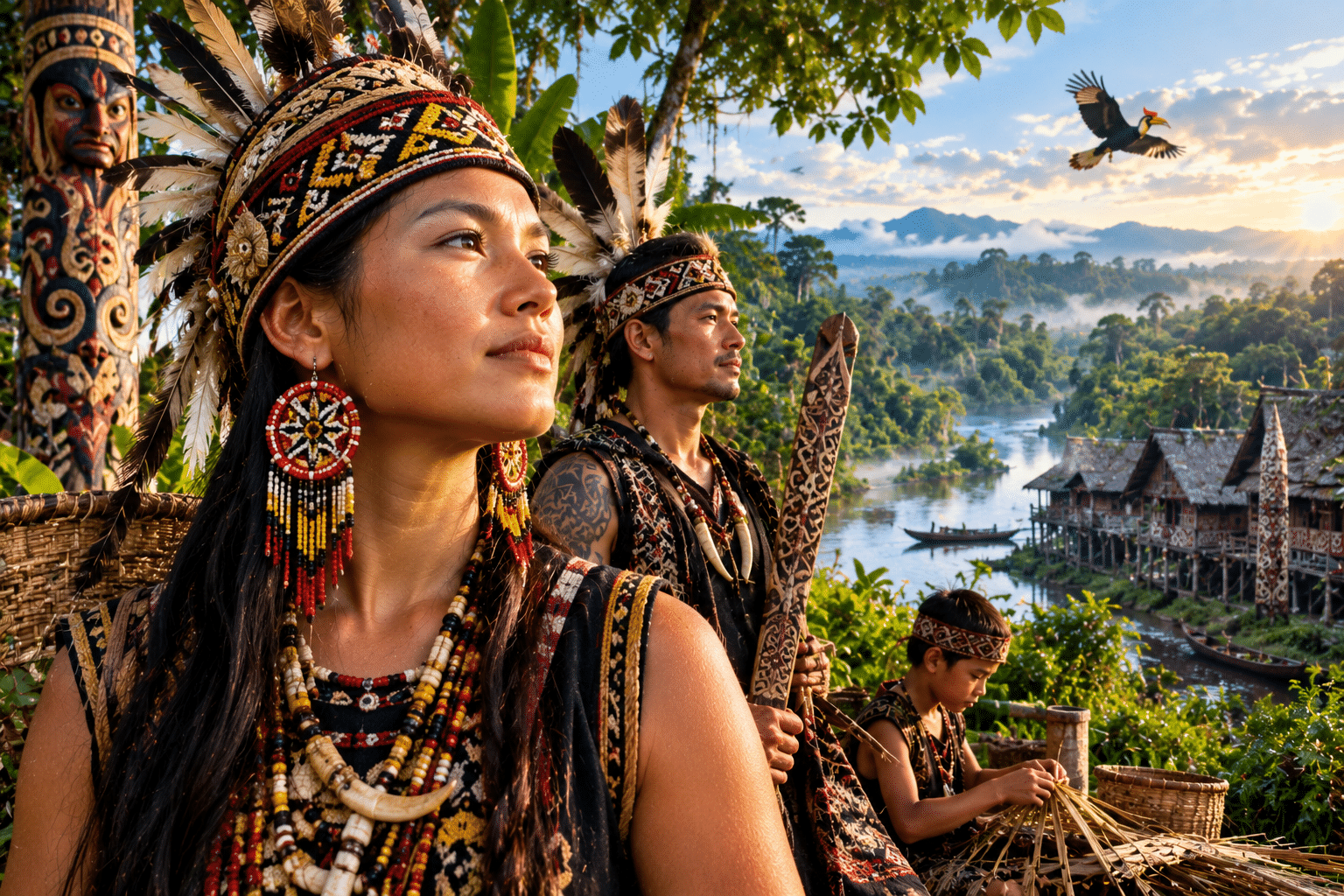
Some cultures teach us to see the natural world differently. They remind us that a forest is more than a collection of trees, a river is more than a source of water, and a home can mean far more than the place where we sleep. The Dayak peoples of Borneo offer a powerful example of this deeper relationship between people, land, and cultural identity. Their heritage reflects centuries of knowledge, remarkable craftsmanship, spiritual traditions, and community life shaped by one of Southeast Asia’s most extraordinary natural environments.
For Tribal World, the Dayak story is an opportunity to look beyond the familiar images of tropical forests and traditional longhouses and discover the people behind them. It is a story of diversity, adaptation, and cultural pride, but also of the challenges Indigenous communities face when the landscapes that sustain their lives undergo rapid change.
Borneo: A Homeland Rich in Life and History
Borneo, the third-largest island in the world, is shared by Indonesia, Malaysia, and Brunei. Its vast rainforests, winding rivers, mountainous interiors, and remarkable biodiversity have supported human communities for generations. Across this landscape, the Dayak peoples have developed distinctive cultures connected to particular territories, languages, livelihoods, and histories.
The term Dayak is a broad collective name for numerous Indigenous peoples of Borneo, rather than the name of one culturally uniform group. Among the communities commonly identified as Dayak are the Iban, Bidayuh, Kenyah, Kayan, Ngaju, and many others. Each has its own traditions, and even neighbouring communities may differ in language, customary law, artistic styles, and ceremonial practices.
Understanding this diversity is essential. There is no single Dayak experience that can represent every community across such a large and culturally varied island.
For many Dayak communities, rivers have historically served as important routes for travel, communication, trade, and access to resources. Forests have provided food, materials, medicinal plants, and spaces connected to ancestral knowledge. The environment has influenced not only how people make a living, but also how communities organise their lives and understand their responsibilities.
What makes this relationship fascinating is the depth of knowledge it can involve. Learning to live in a particular environment requires close observation over time. The behaviour of animals, the growth of plants, the movement of water, and the changing seasons all provide information that can become part of a community’s inherited understanding of its homeland.
The Longhouse: More Than a Place to Live
One of the most distinctive features associated with several Dayak communities is the traditional longhouse. Known by different names among different peoples, longhouses can be substantial communal structures that bring multiple households together within a shared living environment.
Among the Iban, the traditional longhouse is known as a rumah panjang. In some communities, it has historically served as a centre for family life, social interaction, ceremonies, and collective decision-making.
Imagine a home where daily life extends beyond individual rooms and private households. Neighbours are also relatives, shared spaces encourage conversation, and important occasions become collective experiences. This arrangement can create strong opportunities for cooperation and mutual support.
A longhouse is not simply an architectural curiosity. It reflects particular ways of organising relationships and community responsibilities.
The design and use of longhouses vary, and many Dayak people today live in modern houses, towns, and cities. Traditional longhouses may continue to serve as residences, cultural centres, or places for special gatherings, depending on the community.
Still, their cultural significance offers an important insight: the way people build their homes can reflect how they understand community.
In an increasingly individualised world, the longhouse invites us to consider the value of shared spaces where relationships develop naturally. A conversation across a veranda, help offered to a neighbour, or a gathering that brings several generations together can strengthen connections that might otherwise become harder to maintain.
The enduring importance of these structures lies not only in their physical form, but also in the relationships and memories they can hold.
Customary Knowledge and the Meaning of the Forest
For many Dayak communities, traditional knowledge of the forest has been developed through generations of observation and practical experience. Knowledge holders may understand the uses of particular plants, the behaviour of wildlife, local growing conditions, and methods of managing land and resources.
Such knowledge is not identical across Borneo. It varies according to geography, community traditions, and the experiences of individual families.
Agriculture has also played an important role in many Dayak societies. Some communities have practised forms of shifting cultivation, in which land is cultivated for a period and then allowed to recover. The methods, ecological conditions, and customary rules involved differ from place to place.
It is important not to confuse all traditional cultivation with uncontrolled forest destruction. Indigenous land-use systems can involve detailed local knowledge and practices intended to sustain livelihoods over time. Their environmental effects depend on factors such as population pressure, available land, cultivation cycles, and changing economic conditions.
The broader lesson is that traditional ecological knowledge deserves serious attention rather than being dismissed as outdated.
At the same time, Indigenous communities should not be expected to carry the entire burden of protecting the environment. Forest conservation requires fair policies, secure land rights, responsible development, and recognition of the people whose lives are connected to these landscapes.
The Dayak experience encourages us to ask a valuable question: what becomes possible when environmental decisions are made with local communities rather than simply imposed upon them?
Iban Pua Kumbu: Textiles That Carry Cultural Meaning
Dayak artistic traditions are remarkably diverse, but the woven textiles of the Iban people offer a particularly fascinating example of craftsmanship connected to cultural identity.
One important textile tradition is pua kumbu, a handwoven cloth made by Iban women using complex techniques, including intricate pattern-making and traditional forms of resist dyeing. These textiles have been used in ceremonial and cultural contexts, and their designs can carry meanings that extend beyond their visual beauty.
Creating such a cloth requires patience, technical skill, and familiarity with inherited artistic practices. The maker must understand the materials, prepare the fibres, organise the pattern, and manage the weaving process with considerable care.
What is especially interesting is that the finished textile can connect personal creativity with collective cultural knowledge. The individual artist makes choices, but those choices exist within a broader tradition of techniques, meanings, and expectations.
Certain pua kumbu textiles have particular ceremonial significance, and designs should not automatically be treated as interchangeable decorative motifs. Their cultural context matters.
This is a useful reminder in a world where traditional patterns are often copied for commercial fashion without much consideration of their origins. Appreciating an Indigenous art form means recognising the skill of its makers, learning about its history, and respecting the communities that maintain it.
The value of pua kumbu lies not only in what we see, but also in the knowledge, time, and cultural relationships woven into its creation.
Tattoos, Carving, and the Language of Artistic Expression
Traditional body art and woodcarving are also associated with various Dayak communities, although practices and meanings differ considerably across the island.
Among some groups, traditional tattooing has been connected to identity, social experience, personal achievement, spiritual beliefs, or important stages of life. Historically, certain communities also practised tattooing within particular cultural and ritual systems.
These practices should not be generalised to every Dayak person. Their significance depends on the community and historical context, and contemporary attitudes toward traditional body art vary.
Woodcarving offers another expression of artistic knowledge. Decorative elements may appear on buildings, household objects, and ceremonial items, with designs reflecting local aesthetics and cultural traditions.
Such crafts demonstrate that art can operate in several ways at once. It can serve a practical purpose, beautify an object, communicate cultural meaning, and connect a contemporary maker with earlier generations.
Dayak artists today also work in modern media, including painting, photography, sculpture, and contemporary design. Their creativity shows that cultural heritage is not limited to reproducing historical objects. It can provide a foundation for new ideas and artistic expression.
For Tribal World, these traditions offer a valuable reminder that Indigenous creativity should be understood as a living contribution to the arts, rather than merely a subject for museums.
Ceremonies, Music, and Community Celebrations
Cultural celebrations provide important opportunities for many Dayak communities to express their identity, maintain relationships, and pass traditions to younger generations.
One widely recognised celebration is Gawai Dayak, associated particularly with Dayak communities in Sarawak, Malaysia. It is commonly linked to the harvest and the giving of thanks, although the ways it is observed vary between communities and families.
Festivities may involve traditional clothing, music, dancing, shared meals, welcoming visitors, and other activities that bring people together.
For many participants, the significance lies in the opportunity to reconnect with family and community. People who live elsewhere may return to their home villages, while younger relatives gain opportunities to experience customs that they may not encounter in everyday urban life.
Elsewhere in Borneo, different Dayak communities maintain their own ceremonies and seasonal celebrations, shaped by local histories and beliefs.
These occasions remind us that culture is not preserved through knowledge alone. It is also sustained through participation. A young person who learns a traditional dance, helps prepare a festive meal, or listens to an elder explain a custom becomes part of the process through which cultural knowledge continues.
Celebrations also create room for change. Contemporary music, modern clothing, and new forms of communication may appear alongside established traditions, allowing cultural expression to reflect the lives people lead today.
Beliefs, Ancestral Connections, and Changing Spiritual Life
The spiritual histories of Dayak communities are diverse. Some traditional belief systems include relationships with ancestors, spirits, natural forces, and the spiritual significance of particular places or events.
Among the Ngaju Dayak of Central Kalimantan, for example, Kaharingan is a traditional religious system with its own beliefs, ceremonies, and understandings of the relationship between human life and the spiritual world. Its contemporary status and practice have been shaped by Indonesia’s religious and administrative history.
Other Dayak communities have adopted Christianity, Islam, or other religious identities, and many people understand their heritage through a combination of family history, local traditions, and contemporary beliefs.
There is no single religious experience shared by all Dayak peoples.
Recognising this complexity helps us understand how cultures evolve. Religious change does not necessarily erase every inherited custom, just as maintaining a traditional ceremony does not mean rejecting every aspect of modern life.
People interpret their heritage in different ways, and those choices deserve respect.
What matters is the opportunity for communities to maintain meaningful cultural practices, transmit knowledge, and make decisions about their spiritual and social lives without being reduced to simplistic descriptions of their past.
The Challenges Facing Dayak Communities Today
Despite the richness of Dayak heritage, many communities face serious challenges related to land, economic change, and the future of their cultural traditions.
Deforestation, mining, plantation expansion, infrastructure development, and competing claims over land have affected parts of Borneo. The consequences vary by region, but they can include reduced access to customary territories, pressure on traditional livelihoods, and damage to ecosystems that communities have depended upon for generations.
Land is particularly important because it connects several aspects of cultural life at once. It may support food production, provide materials for traditional crafts, contain places of historical significance, and create opportunities for younger people to learn practical knowledge from elders.
When access to ancestral land is restricted, the loss can extend beyond income or resources. It can affect the relationships through which cultural identity is maintained.
Dayak communities are not passive observers of these changes. Many individuals and organisations are involved in land advocacy, cultural education, conservation, community development, and efforts to document local knowledge.
Their priorities are not all the same, and different communities may hold different views about economic development. Respecting their self-determination means recognising that they should have a meaningful role in deciding what happens to their territories and how their futures are shaped.
Keeping Dayak Heritage Alive for the Next Generation
Cultural preservation is often imagined as the protection of old buildings, traditional clothing, or historic objects. These things matter, but the future of Dayak heritage also depends on less visible activities.
It depends on whether children have opportunities to learn their community’s language, whether traditional skills can be taught, whether families can maintain relationships with their home villages, and whether local knowledge is treated with respect.
Digital tools can help record oral histories, document weaving techniques, share music, and connect young people living far from their ancestral communities. Schools and cultural organisations can create opportunities for learning, while artists can introduce traditional ideas to contemporary audiences.
However, preservation works best when communities determine what should be recorded, shared, or kept within particular cultural settings.
Not every tradition needs to be presented to the outside world to remain valuable. Some knowledge belongs within specific family, ceremonial, or community contexts, and respecting those boundaries is part of genuine cultural appreciation.
The aim should not be to freeze Dayak culture in time. It should be to create the conditions in which its people can continue developing their heritage on their own terms.
A Living Heritage With a Future
The Dayak peoples of Borneo remind us that cultural richness is built through relationships between people, their surroundings, and the knowledge passed from one generation to another.
Their longhouses reveal the importance of community life. Their textiles demonstrate the depth of Indigenous craftsmanship. Their languages, ceremonies, and customary knowledge show how identity can remain meaningful through periods of profound change.
But their story is not simply about the past. Dayak communities continue to create, adapt, debate, and make choices about the kind of future they want.
For Tribal World, celebrating their heritage means recognising their diversity, respecting their rights, and appreciating the people who keep their traditions alive. It also means understanding that protecting Indigenous cultures involves more than admiring their artwork or visiting their homelands. It requires listening to their voices and respecting their authority over the decisions that affect their lives.
Perhaps the greatest lesson of the Dayak peoples is that a culture grows strongest when its people can maintain their connections to one another, care for the places that sustain them, and pass their knowledge forward with pride. Their heritage is not simply a legacy left by earlier generations; it is a living story that continues to be written today.