

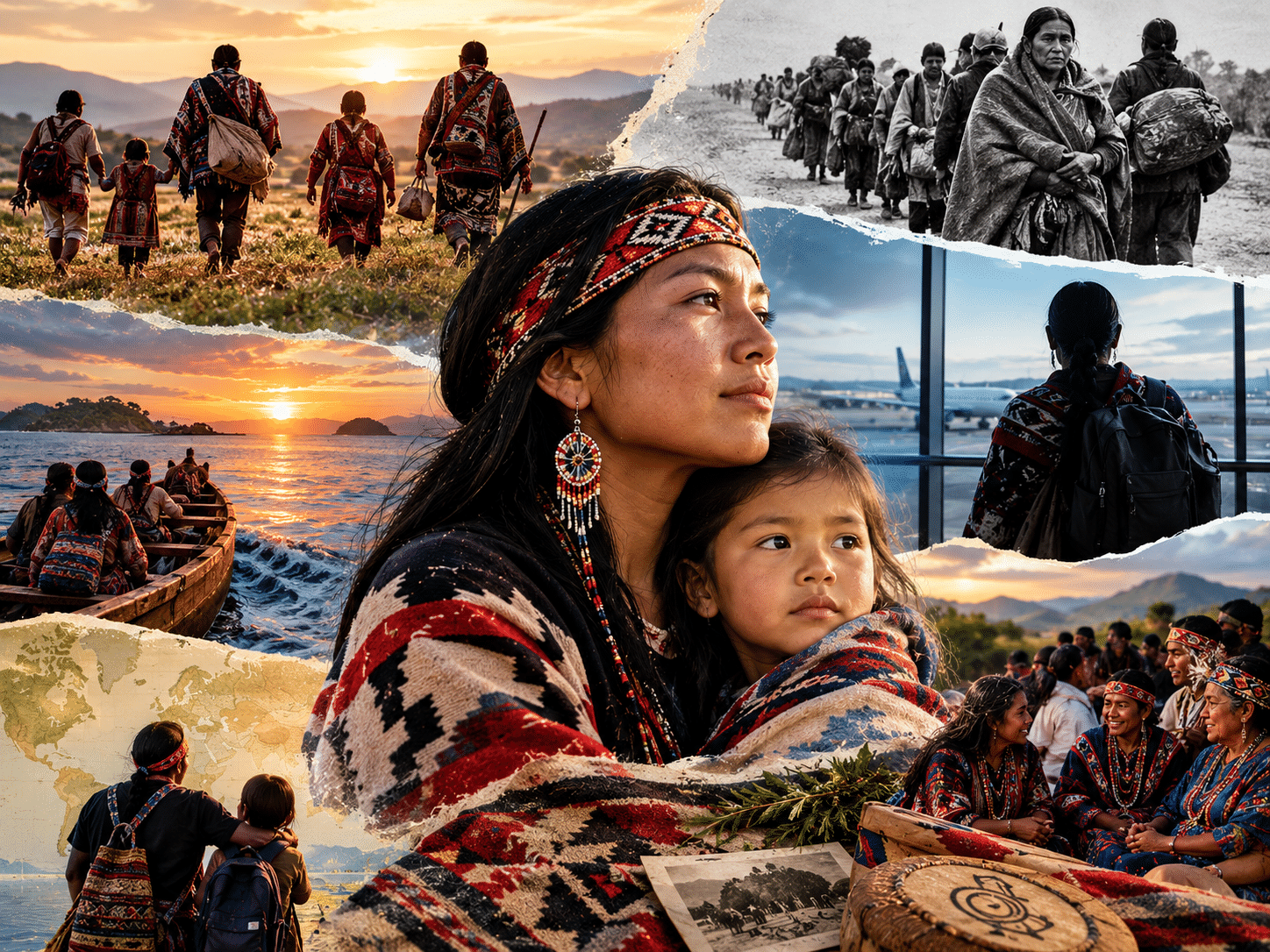
What does it mean to leave the place your family has called home for generations? Imagine moving to a distant city, crossing a national border, or settling in a country where the language, customs, and everyday rhythms feel unfamiliar. You may find new opportunities, but you also carry something with you that cannot easily be packed into a suitcase: your memories, your family history, your language, and your sense of belonging.
For Indigenous peoples around the world, migration can be a deeply personal experience shaped by many different circumstances. Some people move in search of education, employment, or better living conditions. Others are displaced by conflict, environmental changes, land dispossession, or government policies that separate communities from their ancestral territories. Many maintain strong relationships with their homelands even when they live thousands of miles away.
Indigenous migration and diaspora are about more than people moving from one place to another. They are also about identity, cultural survival, family connections, and the determination to preserve traditions in unfamiliar surroundings.
At Tribal World, this subject deserves thoughtful attention because behind every migration story are real people navigating change while trying to hold on to what matters most. Understanding their experiences helps us appreciate the strength of Indigenous communities and the importance of protecting their rights, histories, and cultural identities.
Understanding Indigenous Migration and Diaspora
Migration refers to the movement of people from one place to another, whether temporarily or permanently. Diaspora describes communities living away from an ancestral homeland while maintaining connections to their heritage, identity, or people of origin.
For Indigenous peoples, these experiences can take many forms. A young person might leave a rural community to attend university in a major city. A family might relocate to find work while continuing to speak its ancestral language at home. An entire community may experience displacement when its land is taken, a conflict forces residents to flee, or environmental changes threaten traditional livelihoods.
These experiences are not all the same.
Some migrations are voluntary and create opportunities for individuals and families. Others occur under difficult circumstances, leaving people with little control over their destinations or the possibility of returning home.
The word diaspora also does not describe every Indigenous person who moves away from their community. Some people maintain strong cultural ties across generations, while others experience interrupted connections because of historical displacement, discrimination, or the loss of language.
Recognizing these differences is essential. Indigenous peoples are not one single group with one shared migration history. Their experiences reflect distinct nations, territories, political circumstances, and cultural traditions.
What connects many of these stories is the importance of belonging and the effort to maintain meaningful relationships with people, places, and heritage.
Why Do Indigenous Peoples Migrate?
There is rarely just one reason a person leaves home. Economic pressures, family responsibilities, education, environmental changes, and political circumstances can overlap, creating complicated decisions.
Education and Employment
For many Indigenous people, moving to a town or city opens doors to schools, universities, training programs, and employment that may not be available in their home communities.
A young person might leave home to become a teacher, nurse, engineer, artist, or community advocate. They may hope to build a more secure future while supporting relatives who remain at home.
Yet this journey can involve challenges. Living far from family may mean being separated from familiar customs, community activities, and the people who would ordinarily provide support.
Some migrants eventually return with new skills and experience. Others establish permanent lives elsewhere while remaining actively involved in their communities of origin.
Both paths can be meaningful ways of maintaining a relationship with one’s heritage.
Displacement and Loss of Land
For other Indigenous communities, migration is connected to a much more painful history.
Colonization, forced relocation, land appropriation, resource extraction, and discriminatory government policies have displaced Indigenous peoples in many parts of the world. In some cases, families were separated from their traditional territories or moved to unfamiliar settlements against their wishes.
Land can hold significance far beyond its economic value. It may be connected to ancestral histories, sacred places, traditional food systems, languages, and knowledge passed from one generation to another.
When people lose access to their land, the effects can extend into many areas of life. Cultural practices may become harder to maintain, traditional livelihoods may be disrupted, and younger generations may have fewer opportunities to learn from elders in familiar settings.
These experiences help explain why Indigenous land rights and the right to maintain cultural relationships with ancestral territories remain important issues today.
Environmental Change
Environmental pressures can also influence migration.
Drought, flooding, coastal erosion, changing weather patterns, and damage to local ecosystems may make traditional livelihoods increasingly difficult in some regions. Communities that depend on farming, fishing, herding, or other land-based activities can face difficult decisions when familiar conditions change.
Some people relocate temporarily, while others move permanently. In certain circumstances, migration is a household decision; in others, entire communities may need to consider relocation.
It is important not to portray Indigenous peoples only as victims of environmental change. Indigenous communities possess extensive knowledge of their environments and actively develop adaptation strategies. Their experiences and perspectives can contribute to broader discussions about climate resilience and environmental protection.
The Emotional Side of Leaving Home
Migration is often discussed through statistics, employment figures, and population movements. But the emotional side of leaving home is just as important.
Imagine arriving in a new city where the streets are unfamiliar and nobody speaks your first language. You might feel excited about the opportunities ahead while missing the people and routines that once made life feel familiar.
For Indigenous migrants, this experience can be intensified when their cultural practices are misunderstood or when they encounter prejudice because of their identity.
Something as ordinary as preparing a traditional meal, speaking an ancestral language, or participating in a cultural celebration can become more difficult when community networks are far away.
There may also be a feeling of being caught between different worlds. People can develop new friendships, adopt unfamiliar routines, and build successful lives while still feeling deeply connected to their homeland.
This does not mean that their identity is divided or incomplete. People can belong to more than one place and maintain several meaningful connections at the same time.
For many, the experience of migration becomes a journey of discovering how to carry their heritage forward while adapting to new circumstances.
Keeping Indigenous Languages and Traditions Alive
One of the most important questions facing many Indigenous diaspora communities is how to preserve cultural knowledge across generations.
Language is central to this challenge. An ancestral language can carry expressions, histories, place names, and ways of understanding the world that may not translate easily into another language.
When families move away from their traditional communities, children may grow up using the dominant language of their new environment. Over time, opportunities to hear and speak their ancestral language can become limited.
However, migration does not automatically lead to cultural loss.
Families can keep languages alive through everyday conversations, storytelling, songs, reading, and lessons with elders or language teachers. Community organizations may arrange cultural classes, while digital tools can help people connect with speakers in other regions.
Traditional food, music, dance, weaving, craftwork, and ceremonies can also help maintain cultural connections.
These practices should not be reduced to symbols or performances for outsiders. Their deeper value lies in the relationships and knowledge they sustain within communities.
A child who learns a family recipe from a grandparent may also learn the story of where its ingredients come from. Someone who learns a traditional song may discover the history associated with it.
In this way, cultural knowledge can continue to grow even when families live far from their ancestral homes.
The Role of Elders and Younger Generations
Elders often play an important role in maintaining cultural continuity. They may carry knowledge of traditional practices, community histories, language, and relationships with ancestral territories.
For families living in diaspora, opportunities to spend time with elders can be especially valuable. Their stories can help younger people understand their heritage and develop a stronger sense of identity.
But cultural preservation should not be placed entirely on older generations.
Young Indigenous people also contribute through education, art, music, community organizing, language revitalization, and digital storytelling. Some use contemporary platforms to share their cultures with relatives abroad and connect with Indigenous communities in other parts of the world.
Their work shows that tradition and modern life do not have to compete.
A young person can use modern technology while maintaining an ancestral language. An Indigenous artist can explore contemporary styles while drawing inspiration from community histories. A student can pursue a career overseas and remain committed to supporting their home community.
Culture survives not because every generation lives exactly as the previous one did, but because people continue to find meaningful ways to carry their heritage forward.
Indigenous Diaspora and the Search for Identity
Identity can become a particularly important question for people who grow up away from their ancestral homeland.
A person may know their family background but have limited opportunities to learn the language or participate in cultural traditions. Another may feel deeply connected to their heritage through family relationships, community involvement, or regular visits home.
There is no single experience that defines Indigenous diaspora identity.
Some people feel an immediate connection to their ancestral culture. Others discover that connection gradually, perhaps through conversations with relatives, research into family history, or participation in cultural events.
These journeys deserve respect rather than judgment.
Cultural identity is not simply a checklist of traditions someone must perform to prove belonging. At the same time, Indigenous identity can involve specific relationships to community, ancestry, collective recognition, and the rights of Indigenous peoples. It should not be reduced to personal interest or ancestry alone.
Listening to Indigenous communities themselves is important when discussing identity, belonging, and membership.
For diaspora communities, creating welcoming spaces where people can learn, ask questions, and build relationships can help strengthen connections across generations.
How Technology Connects Communities Across Borders
Distance once made communication with relatives and cultural communities difficult and expensive. Today, digital technology can help Indigenous people maintain relationships across countries and continents.
Video calls allow families to speak with elders. Online language classes connect learners with teachers. Community websites and social media groups help people share events, news, artwork, music, and cultural education.
Digital archives can also support efforts to preserve photographs, oral histories, and language resources when communities choose to make such materials available.
However, technology must be used thoughtfully. Some Indigenous knowledge is sacred, private, or restricted, and not every story or cultural practice should be recorded or shared publicly.
Communities should have a say in how their knowledge is collected, stored, and presented. Respect for cultural authority and consent is just as important online as it is in person.
When used responsibly, technology can reduce the distance between relatives, support language learning, and help younger generations develop stronger relationships with their heritage.
It cannot replace every aspect of living within a community, but it can create valuable connections where physical distance makes regular contact difficult.
What Matters Most: Rights, Recognition, and Respect
Understanding Indigenous migration and diaspora means looking beyond individual journeys to consider the wider conditions that shape them.
Indigenous peoples have rights relating to their cultures, languages, lands, and communities. International human rights frameworks, including the United Nations Declaration on the Rights of Indigenous Peoples, recognize important principles concerning self-determination, cultural preservation, participation in decisions, and relationships with traditional lands.
These principles matter because migration does not erase a person’s cultural identity or automatically end a community’s connection to its territory.
People living away from home may still advocate for land protection, support cultural education, contribute to community projects, and participate in decisions affecting their people.
Meaningful support begins with listening to Indigenous voices rather than making assumptions about what communities need.
It also means recognizing that Indigenous peoples are contemporary societies with diverse ambitions and experiences, not simply guardians of traditions from the past.
Education, fair employment, cultural recognition, access to services, and respect for community rights can all contribute to better outcomes for Indigenous people wherever they live.
Final Thoughts: Home Is More Than a Place on a Map
Indigenous migration and diaspora reveal the many ways people navigate change while maintaining connections to their roots.
Some leave home to pursue education or employment. Others experience displacement that changes their lives and separates them from familiar landscapes. Many build new communities far away while continuing to preserve their languages, stories, and cultural practices.
Their experiences remind us that home is not always defined by a single location. It can also live in a language spoken with family, a story remembered from childhood, a traditional meal, a song shared across generations, or a commitment to the well-being of one’s people.
For Tribal World, exploring this subject is an opportunity to recognize both the challenges Indigenous migrants face and the creativity, resilience, and determination with which many maintain their cultural connections.
We should also remember that resilience does not make displacement harmless. Communities deserve the freedom to maintain their identities, protect their territories, and make decisions about their futures.
The most meaningful way to understand Indigenous diaspora is to listen to the people who experience it, respect their different journeys, and recognize their right to define what belonging means to them.
Indigenous migration is not simply a story of leaving home. It is also a story of carrying history, protecting identity, building connections, and finding ways for cultural heritage to survive across generations and borders. Wherever Indigenous people go, their stories deserve to be heard, their rights deserve to be respected, and their connections to their communities deserve to be recognized.