

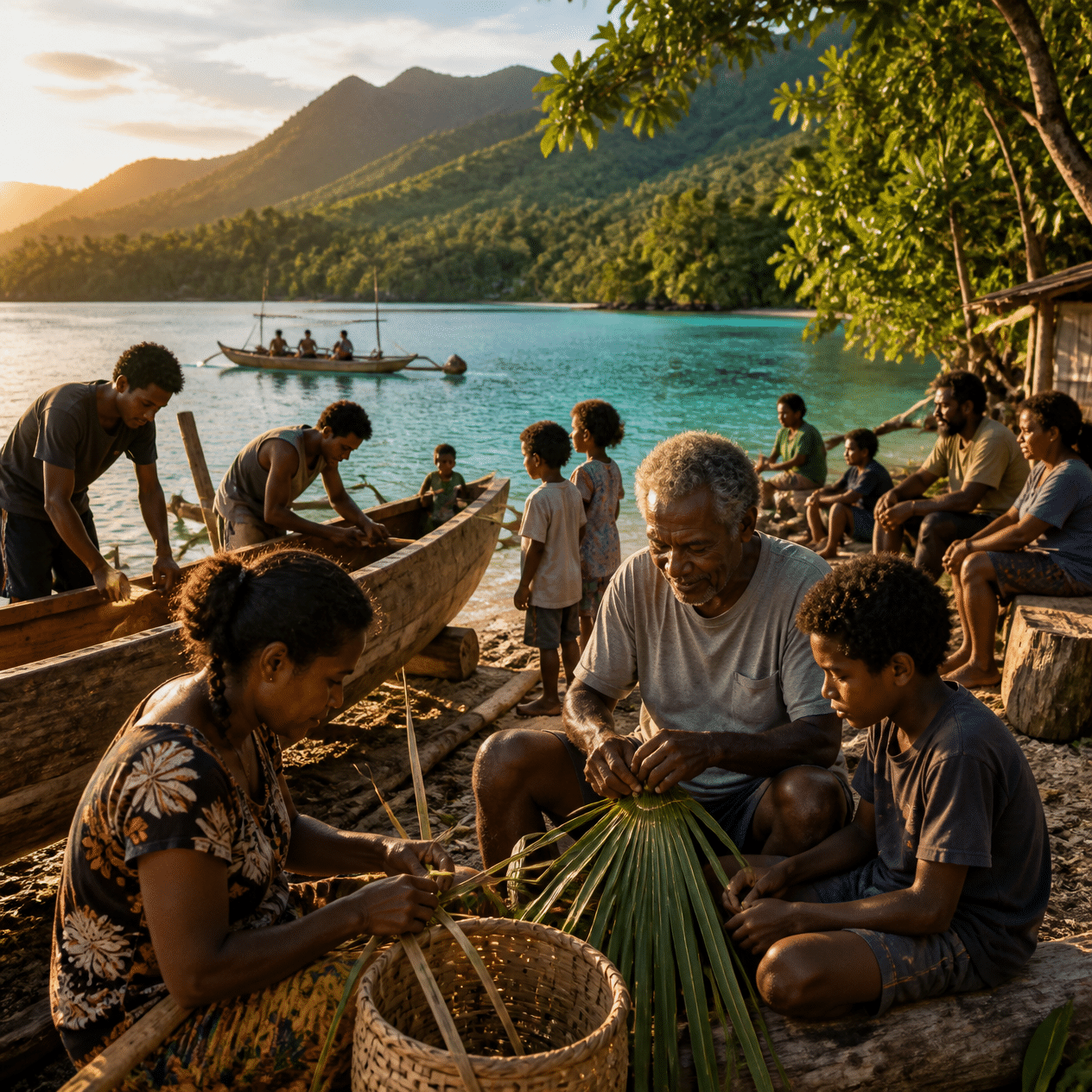
Imagine waking up on a small Pacific island to the sound of waves moving gently against the shore, birds calling from the surrounding forest, and families beginning their daily routines. Somewhere nearby, an elder shares a story with a younger relative, a fisher prepares a canoe, and a family gathers food for the day. These ordinary moments offer a glimpse into the cultural world of the Indigenous peoples of the Solomon Islands, a nation where history, community, nature, and identity remain closely connected. Although the country is often celebrated for its beautiful beaches, coral reefs, and tropical scenery, its greatest cultural richness lies in the people who have called these islands home for generations.
Located in the southwestern Pacific Ocean, the Solomon Islands is an archipelago made up of numerous islands and smaller communities, each with its own experiences, traditions, and ways of understanding the world. The country’s Indigenous population is culturally diverse, with Melanesian peoples forming the majority and Polynesian communities living in parts of the archipelago. There is no single tradition that represents every island, and this diversity is one of the most fascinating aspects of Solomon Islands society. Communities have developed their own languages, customary practices, artistic expressions, family relationships, and connections to the surrounding environment. To understand their heritage properly, it is important to look beyond the idea of a tropical paradise and recognise a living society whose people continue to balance ancestral values with the realities of modern life.
One of the most remarkable features of the Solomon Islands is its extraordinary linguistic diversity. Dozens of Indigenous languages are spoken throughout the country, reflecting centuries of settlement, movement, and cultural development. Each language carries more than everyday conversation. It holds family histories, traditional place names, local knowledge, humour, songs, and expressions that may have no exact equivalent in another language. Solomon Islands Pijin helps people from different linguistic backgrounds communicate, while English is used in formal education and government. Yet local languages remain deeply meaningful because they connect people to the places and communities that shaped their identities. Imagine a grandmother explaining the name of a nearby river to her grandchild. Her explanation might include where the name originated, which families have historical connections to the area, and what the river means to the surrounding community. In a few minutes, she may pass on knowledge that no textbook could fully capture. This is how cultural heritage often survives: not through grand ceremonies alone, but through ordinary conversations shared between generations.
For many Indigenous Solomon Islanders, the relationship with ancestral land is equally important. Land may provide space for homes, gardens, and livelihoods, but its significance often extends much further. It can represent family inheritance, community belonging, historical identity, and the memory of ancestors. Forests, rivers, coastlines, and reefs may also carry customary meanings and responsibilities. In many communities, customary land rights are connected to family or clan relationships, although the precise arrangements differ from one place to another. This helps explain why decisions about logging, mining, agriculture, and other development projects can be sensitive. An area that appears commercially valuable to an outside company may be a place where families have gathered food, maintained ancestral connections, and passed down knowledge for generations. Meaningful consultation, respect for customary ownership, and fair discussions about benefits are therefore essential when development affects Indigenous communities. Progress should not require people to surrender their identity or lose control over places that hold deep cultural significance.
Community relationships also play a major role in daily life. Extended families and wider networks of relatives can provide support with childcare, food preparation, celebrations, and difficult circumstances. The idea of wantok, a term associated with shared language and broader relationships of solidarity, helps explain how connections between people can extend beyond a single household. When a family faces a challenge, relatives and community members may contribute time, practical help, food, or other resources. These relationships can create a strong sense of belonging, particularly in places where formal services are limited. At the same time, family responsibilities can bring pressures, and younger people may sometimes find themselves balancing community expectations with education, employment, and personal ambitions. Like every society, Solomon Islands communities continue to negotiate the relationship between inherited values and changing lifestyles.
Traditional food practices reveal another important connection between culture and the natural world. Depending on the island and local environment, families may grow taro, yams, cassava, bananas, and other crops, while fishing and gathering provide additional sources of food. Coconuts, leafy vegetables, fish, and shellfish can form part of local diets, with considerable variation between communities. These practices reflect generations of experience with soil, rainfall, tides, growing seasons, and available resources. Traditional ecological knowledge can help people recognise useful plants, understand local fishing grounds, and respond to environmental changes. For example, experienced fishers may notice that certain species become more abundant during particular seasons or that a reef is recovering after fishing pressure decreases. When this knowledge is combined with scientific research and community-led conservation, it can contribute to more responsible resource management. Some Pacific communities use customary restrictions on harvesting, often described through terms such as tambu or tabu, although the specific rules and names vary by location. These practices demonstrate how cultural responsibilities can support environmental stewardship when they are appropriate to local conditions.
The connection between people and nature is becoming increasingly important as climate change affects island communities. Coastal erosion, rising sea levels, coral bleaching, changing rainfall, and severe weather can threaten homes, gardens, freshwater supplies, and fishing livelihoods. For families living close to the ocean, environmental change is not simply an abstract scientific concern. It can influence where they live, what they grow, how they earn an income, and whether younger generations can remain in their ancestral communities. Indigenous knowledge can contribute valuable observations and adaptation strategies, but communities also need access to scientific information, reliable infrastructure, funding, and meaningful participation in decisions about their future. Protecting cultural heritage therefore means protecting the natural environments that support it. A traditional fishing practice cannot continue in the same way if the surrounding reef is severely damaged, just as ancestral land loses part of its cultural importance when families can no longer safely live on or access it.
Art, music, storytelling, and craftsmanship provide other windows into the cultural life of the Solomon Islands. Across different communities, people create carved wooden objects, canoes, woven baskets, shell ornaments, and other items that may combine practical uses with artistic and cultural meaning. Local materials, designs, and techniques reflect the environments and histories of the people who produce them. Music and dance bring people together during celebrations, community gatherings, and important social occasions, while oral storytelling helps preserve memories, values, and knowledge about the past. These traditions are not frozen in time. Contemporary artists and musicians continue to find new ways to express their identities, sometimes combining traditional influences with modern instruments, digital platforms, and international styles. This creativity demonstrates that cultural preservation does not mean rejecting change. A tradition can remain meaningful even as the ways people practise and express it evolve.
Belief and spirituality in the Solomon Islands also reflect a complex history. Christianity is widespread and has influenced education, community organisation, and family life across much of the country. Indigenous customs and ancestral traditions have developed in different relationships with Christian beliefs, depending on local history and community preferences. Some practices have changed, others have continued, and new forms of cultural expression have emerged. It would be inaccurate to describe all Indigenous Solomon Islanders as following one spiritual system or interpreting their traditions in the same way. Their experiences are diverse, and individual beliefs can be shaped by family, community, personal conviction, and changing circumstances. Respecting this diversity is essential to understanding the country without reducing its people to stereotypes.
The history of the Solomon Islands reaches back thousands of years, long before European contact and colonial administration. Over generations, communities established settlements, developed agricultural practices, travelled between islands, and maintained relationships through trade and cultural exchange. Later encounters with European explorers, missionaries, colonial authorities, and foreign labour recruiters brought major changes. The Second World War also left a lasting mark, particularly through the military campaigns fought on Guadalcanal and the wartime disruption experienced across the region. The country became self-governing in 1976 and achieved independence on 7 July 1978. Yet independence did not mean that every challenge disappeared. Indigenous communities continue to navigate questions about economic opportunity, environmental protection, political representation, and the preservation of cultural knowledge. Their history is not simply a story of outside influence; it is also a story of resilience, adaptation, and the determination of local people to shape their own futures.
Today, one of the most important questions concerns how younger generations will maintain their connections to ancestral culture while pursuing new opportunities. Young Solomon Islanders attend school, use smartphones, participate in online communities, move between islands, and seek employment in an increasingly connected world. These experiences can broaden horizons, but they may also reduce the time available for learning local languages, traditional skills, and family histories. Cultural knowledge is most likely to remain alive when it is part of everyday experience rather than something encountered only during special celebrations. A young person learning to identify local plants from an elder, helping to prepare a traditional meal, listening to family stories, or understanding the history of a customary place is participating in the continuation of a living heritage. Community organisations and schools can support these connections by creating opportunities for intergenerational learning and by recognising Indigenous knowledge as a valuable part of education.
There are also practical ways for outsiders to support cultural preservation. Visitors can learn about the particular community they are visiting instead of assuming that every island follows the same customs. Photographers should seek permission before taking pictures of people or culturally significant activities, while researchers and content creators should respect restrictions on sensitive knowledge. Purchasing locally made crafts from artists or community enterprises can help support livelihoods when transactions are fair and products are represented honestly. Development organisations should consult the people directly affected by their projects, especially when customary land and natural resources are involved. These actions matter because appreciation without respect can easily become exploitation. Indigenous communities should have the freedom to decide which aspects of their culture they wish to share publicly and which they prefer to protect within their own families and communities.
Ultimately, the Indigenous peoples of the Solomon Islands offer an important reminder that heritage is not merely a collection of old objects, traditional clothing, or historical stories. It is a relationship between people, place, memory, and responsibility. It lives in the language spoken at home, the knowledge carried by experienced fishers, the food grown in family gardens, the stories told to children, and the decisions communities make about their land and resources. Their cultures are diverse and continually evolving, shaped by both ancestral knowledge and contemporary aspirations. For Tribal World, sharing their stories responsibly means recognising Indigenous Solomon Islanders not as distant figures from a forgotten past, but as living communities with distinct identities, valuable knowledge, and the right to determine their own futures.
The most meaningful way to appreciate this heritage is to listen carefully, learn without assumptions, and recognise that cultural survival depends on more than admiration. It depends on protecting languages, respecting customary rights, supporting community-led initiatives, and creating opportunities for younger generations to carry their traditions forward in ways that reflect their own choices. The Solomon Islands is more than a collection of beautiful Pacific islands. It is a homeland of enduring relationships, remarkable cultural diversity, and people whose connection to their heritage continues to give meaning to the present while helping shape the future.
Tribal World — Celebrating Indigenous cultures, honouring ancestral wisdom, and keeping the world’s living heritage alive.