

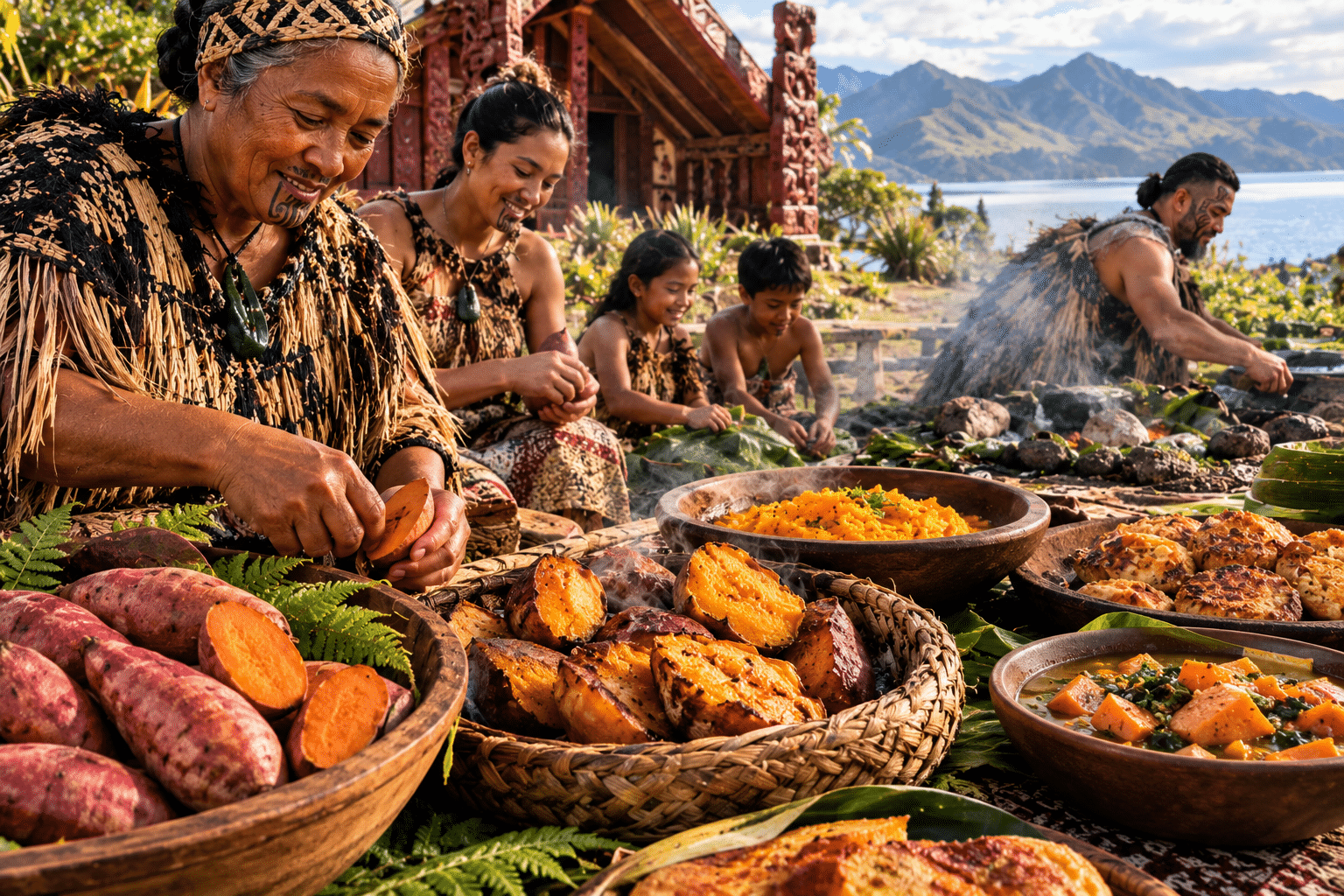
Some foods feed the body. Others carry the memories of a people, the wisdom of their ancestors, and the stories of a land that continues to nourish generations.
There is something comforting about the smell of kūmara roasting slowly, its natural sweetness deepening as the edges become golden and tender. For many people, sweet potato is a familiar ingredient found in everyday meals, family kitchens, and seasonal dishes. Yet, behind this humble root lies a much richer story, one of ancestral knowledge, cultural identity, agricultural resilience, and the remarkable versatility of traditional food.
Kūmara, the Māori name commonly used for sweet potato in Aotearoa New Zealand, holds a special place in Māori heritage. It is more than an ingredient to be peeled, chopped, boiled, or roasted. It represents a connection between people and the land, between traditional growing practices and modern food culture, and between the knowledge of earlier generations and the choices we make today.
To explore kūmara is to look beyond the familiar roast and discover how one humble crop can tell a story about survival, adaptation, creativity, and belonging.
A Root With Deep Ancestral Connections
Long before kūmara became a familiar ingredient in contemporary kitchens, it was part of the agricultural and cultural life of Māori communities.
Sweet potato originated in the Americas and travelled across the Pacific through pre-European contact networks. Its presence in Aotearoa is closely associated with Māori voyaging, settlement, and the transfer of cultivated plants and knowledge across the ocean. The precise history of its movement through the Pacific remains a subject of scholarly research, but kūmara is firmly embedded in Māori traditions and historical relationships with the land.
Growing this crop in Aotearoa required knowledge, adaptation, and care. The climate in many parts of New Zealand differed from the warmer tropical environments in which sweet potato was traditionally cultivated. Māori communities developed growing and storage practices suited to local conditions, demonstrating a sophisticated understanding of seasonal patterns, soil, temperature, and cultivation.
This history reminds us that traditional agriculture is not simply about planting seeds and waiting for a harvest. It involves generations of observation, experimentation, and the transmission of practical knowledge.
Kūmara became more than a source of nourishment. It became part of the story of how Māori communities established food systems, adapted to new environments, and maintained their relationships with the whenua—the land.
The Wisdom Beneath the Soil
One of the most fascinating aspects of kūmara is the knowledge associated with growing it.
A successful harvest depends on more than the crop itself. Soil conditions, drainage, temperature, seasonal timing, and protection from environmental pressures all influence how the plants develop.
Traditional Māori cultivation practices included carefully prepared gardens and mounds that helped create suitable growing conditions. These methods reflected an understanding of how to work with the local environment rather than simply impose a single agricultural approach upon it.
The knowledge surrounding kūmara also connects to the wider Māori concept of mātauranga Māori, which encompasses Māori knowledge, values, understandings, and ways of interpreting the world.
Such knowledge is not merely a collection of historical techniques. It is part of a living intellectual and cultural tradition that continues to evolve.
Today, growers face changing weather patterns, soil pressures, and other agricultural challenges. Traditional knowledge can contribute useful local perspectives when considered alongside contemporary horticultural research and environmental monitoring.
The lesson is not that older methods must always replace modern ones. It is that the future of food production becomes richer when we recognise the value of knowledge developed through long relationships with the land.
Sometimes, innovation begins by paying closer attention to what earlier generations already understood.
Beyond the Roast: Discovering Kūmara’s Versatility
When people think of kūmara, roasted sweet potato may be the first dish that comes to mind. Its caramelised edges, soft centre, and natural sweetness make it an easy favourite. But its culinary possibilities extend far beyond the roasting tray.
Kūmara can be boiled and mashed into a smooth, comforting side dish. It can be added to soups and stews, where it contributes body, colour, and a gentle sweetness. It can be baked into savoury pies, incorporated into fritters, or transformed into purées that complement a variety of ingredients.
Its texture also makes it useful in baking. Depending on the recipe, cooked kūmara can contribute moisture and softness to breads, cakes, and other baked goods.
Different varieties offer different colours, textures, and flavours, creating opportunities for cooks to experiment. Some are particularly suited to roasting, while others work beautifully in mashed dishes or soups.
Yet versatility is not only about finding new recipes. It is also about understanding how an ingredient can fit into different circumstances.
A family might prepare kūmara simply for an everyday meal, serve it alongside other foods during a gathering, or incorporate it into a contemporary dish that reflects a cook’s personal creativity.
This flexibility is part of what has allowed the crop to remain relevant across changing food cultures.
Still, its cultural identity deserves to remain visible. Exploring new ways to prepare kūmara should go hand in hand with recognising its Māori name, history, and significance in Aotearoa.
Food as a Connection Between Generations
Some of our strongest food memories begin in childhood.
Perhaps it is watching a grandparent prepare a meal, helping to wash vegetables in the kitchen, or waiting impatiently for something to come out of the oven. Over time, these ordinary experiences become part of how we remember home.
Traditional foods often carry this emotional weight because they connect the practical act of eating with the experience of belonging.
For Māori communities, kūmara has cultural significance that extends beyond its nutritional value. It features in traditional narratives, historical accounts, and relationships between people, land, and food. Its place in Māori heritage cannot be reduced to a recipe or a modern culinary trend.
Food traditions also help pass knowledge between generations. Through growing, preparing, and sharing food, younger people can learn about ingredients, seasonal practices, cultural values, and the responsibilities associated with caring for the environment.
Not every family will prepare kūmara in the same way, and traditions naturally change over time. Some households may follow familiar methods, while others develop new interpretations that reflect contemporary tastes and lifestyles.
What matters is that these changes can take place without losing sight of the knowledge and cultural connections that give the ingredient meaning.
A dish may evolve, but the story behind it can continue to be told.
Kūmara and the Meaning of Manaakitanga
In Māori culture, manaakitanga is commonly associated with hospitality, care, generosity, and the responsibility to show respect towards others.
Food can be an important expression of these values. Preparing a meal, welcoming visitors, and sharing what is available can create opportunities to strengthen relationships and demonstrate care.
Kūmara may form part of meals shared with family, friends, and guests, contributing to the wider experience of gathering around food.
There is something meaningful about a dish that can be prepared simply for an ordinary evening yet also find a place at a larger gathering. It reminds us that hospitality does not always depend on elaborate ingredients or expensive presentation.
Sometimes, it is found in the willingness to prepare something with care and make sure there is enough to share.
Although no single food can represent the full depth of Māori cultural values, kūmara offers an opportunity to reflect on the connections between food, community, and responsibility.
These connections are relevant far beyond the kitchen. They remind us that nourishing others involves more than serving a meal. It also involves respect, generosity, and an appreciation of the people gathered around the table.
Tradition Meets the Modern Kitchen
Modern cooking has created countless opportunities to experiment with traditional ingredients.
Today, kūmara appears in everything from simple home-cooked meals to restaurant menus and contemporary food creations. Cooks combine it with herbs, spices, grains, vegetables, and proteins to create dishes that reflect a wide range of culinary influences.
Some preparations remain close to familiar household traditions, while others explore new textures, flavour combinations, and presentation styles.
This evolution shows that traditional ingredients do not need to remain confined to historical recipes. They can continue to inspire creativity and adapt to contemporary lifestyles.
However, there is an important distinction between celebrating an ingredient and separating it from its cultural origins.
When traditional foods become popular in wider markets, the histories and communities associated with them can sometimes disappear from the conversation. An ingredient may be praised as a new culinary discovery even though Indigenous communities have cultivated and valued it for generations.
Respectful innovation means acknowledging these histories rather than treating them as an afterthought.
For kūmara, this includes recognising its place in Māori heritage and appreciating the knowledge that helped sustain its cultivation and use in Aotearoa.
Modern design and culinary creativity are at their best when they build on cultural understanding rather than erase it.
A Crop With Lessons for Sustainable Living
Kūmara also offers an opportunity to think more broadly about food resilience and sustainable agriculture.
As a crop, sweet potato can produce edible storage roots and, in suitable conditions, leafy growth that can also be used as food. Its performance depends on variety, climate, soil, water availability, and growing practices, but it can contribute to diverse food systems.
Traditional crops are particularly valuable when we consider the importance of agricultural diversity. Relying on a narrow range of food plants can leave communities vulnerable to particular pests, diseases, and environmental pressures.
Maintaining knowledge about different crops, local growing conditions, and appropriate cultivation practices can help strengthen food systems.
There is also a practical lesson for home cooking. Kūmara can be incorporated into many meals, helping cooks make use of a versatile ingredient in different ways. Leftover cooked kūmara, for example, can often be added to soups, mashed dishes, or suitable baked recipes rather than being discarded.
However, sustainability involves more than the characteristics of a crop. Responsible growing practices, careful water management, appropriate storage, and reduced food waste all contribute to a more thoughtful approach.
The deeper message is that food resilience depends on diversity, knowledge, and the ability to adapt.
Kūmara’s history reminds us that crops are not merely commodities. They are part of relationships between people, environments, and generations of agricultural experience.
Protecting Heritage Without Freezing It in Time
Cultural traditions are sometimes presented as though they belong entirely to the past. Yet the communities that carry them continue to live, work, innovate, and make choices about their futures.
Māori relationships with kūmara are part of a living heritage, not simply a historical story to be admired from a distance.
Supporting that heritage means respecting Māori knowledge holders, recognising the cultural significance of traditional crops, and ensuring that Indigenous perspectives are included in discussions about food, agriculture, and environmental stewardship.
It also means understanding that communities should have a voice in how their knowledge is shared and represented.
Traditional knowledge should not be treated as freely available material for others to commercialise without appropriate consultation, acknowledgement, or consideration of community interests.
At the same time, younger generations should have opportunities to learn about traditional foods in ways that connect cultural knowledge with contemporary life.
Gardening projects, cooking workshops, community food initiatives, and educational programmes can all create opportunities for this knowledge to remain active.
Preservation is most meaningful when it allows a tradition to grow while respecting the people who sustain it.
Beyond the Roast: A Future Rooted in Heritage
Perhaps the most beautiful thing about kūmara is the way it connects so many parts of life.
It begins in the soil, where agricultural knowledge and environmental conditions shape the harvest. It enters the kitchen, where experience and creativity transform it into a meal. It reaches the table, where food becomes part of family life, hospitality, and cultural expression.
And through these everyday moments, it carries a history that stretches far beyond any single preparation method.
Kūmara reminds us that an ingredient can be practical and meaningful at the same time. It can nourish the body while connecting people to ancestral knowledge, cultural identity, and a sense of belonging.
Its versatility invites us to experiment, but its heritage encourages us to remain curious about where our food comes from and whose knowledge has helped sustain it.
We do not need to choose between tradition and innovation. We can roast kūmara in a familiar way, discover a new recipe, support local growers, and learn more about its cultural significance—all while recognising that its story is much larger than our own experience of eating it.
Because beyond the roast lies a deeper story: a story of land, knowledge, resilience, and generations of people who have transformed a humble root into a lasting part of their cultural heritage.
Rooted in ancestral knowledge, nourished by the land, and reimagined in modern kitchens, kūmara reminds us that the foods we inherit can continue to inspire the futures we create.
#BeyondTheRoast #Kūmara #MāoriHeritage #AotearoaNewZealand #TraditionalFood #IndigenousKnowledge #FoodAndCulture #AncestralWisdom #CulinaryHeritage #SustainableFood #TraditionalCrops #LivingHeritage