

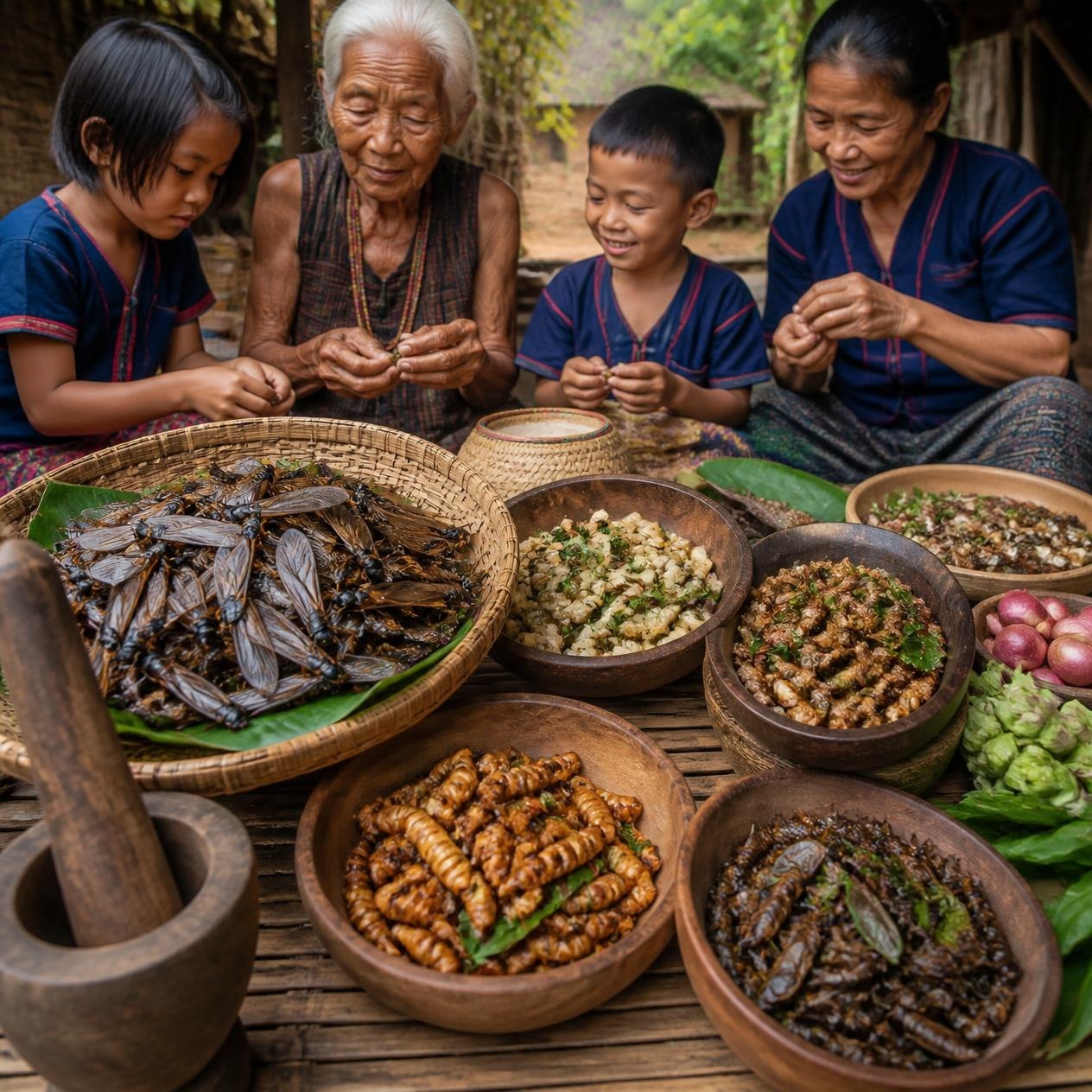
What if one of nature’s smallest creatures could tell us a powerful story about food, survival, sustainability, and the wisdom of our ancestors?
In many parts of Africa and other regions of the world, termites and flying ants are more than insects that appear after the rain. They are seasonal delicacies, treasured ingredients, and an important part of traditional food cultures passed down through generations.
For some communities, the arrival of winged termites or flying ants signals a special time of the year. Children gather with excitement, families prepare their collection baskets, and the insects are gathered, cleaned, roasted, fried, or prepared according to local customs.
What may seem unfamiliar to one person can be a cherished delicacy to another.
Behind these tiny creatures lies a fascinating story about how people have learned to recognize the gifts of their environment and turn seasonal abundance into nourishing food.
WHEN THE RAINS BRING A SEASONAL DELICACY
In many tropical and subtropical regions, the arrival of seasonal rains creates the right conditions for certain termites and ants to emerge in large numbers for their reproductive flights.
Winged termites, often called alates, leave their colonies to mate and establish new colonies. Certain ant species also produce winged reproductive adults that emerge under suitable environmental conditions.
The timing varies according to species, rainfall, temperature, and location.
In communities where these insects are traditionally eaten, their emergence can create a short-lived opportunity to collect a food that may not be available in the same abundance throughout the year.
For people familiar with these seasonal patterns, the weather can be more than a forecast. It can be a signal that a valued traditional food may soon appear.
Nature has its own calendar, and for many traditional food cultures, the first rains can announce a feast that has been anticipated for generations.
TERMITES: SMALL INSECTS WITH BIG NUTRITIONAL VALUE
Edible termites are consumed in various African communities, particularly where local species emerge in abundance.
Depending on the species and preparation method, termites can provide protein, fats, and minerals. Their nutritional composition varies, so not every termite species or preparation offers the same nutritional benefits.
One reason termites are valued as food is their relatively rich energy content, particularly when the insects are prepared with their natural fats retained.
How are termites prepared?
Traditional preparation methods vary by community, but may include:
- Roasting: Heating the insects until they develop a toasted flavor and crisp texture.
- Dry frying: Cooking them in a pan, sometimes allowing their natural fats to provide much of the cooking oil.
- Frying: Preparing them with a little oil and, where customary, salt or other seasonings.
- Drying: Preserving suitable edible species for later consumption using established local practices.
Their flavor is often described as nutty, earthy, or savory, although the taste and texture depend on the species and preparation.
For people who grew up eating termites, the experience may carry memories of childhood, family gatherings, and the excitement of collecting food after the rains.
For someone trying them for the first time, the idea may be surprising. Yet food traditions around the world demonstrate that what people consider a delicacy is often shaped by familiarity, history, and culture.
FLYING ANTS: A SEASONAL TREAT FROM NATURE
Flying ants are another traditional insect food in several parts of the world.
In some African communities, winged ants are collected during their seasonal flights and prepared as a snack or incorporated into meals. Particular species are especially valued because of their size, availability, or taste.
Their nutritional composition varies by species and life stage, but edible ants can provide protein and fats.
Depending on local traditions, they may be roasted, fried, or otherwise cooked before eating.
Their texture can range from crisp to slightly chewy, while their flavor may be nutty or savory.
The collection itself can be an important part of the experience. When the insects emerge in large numbers, families and neighbors may gather them using traditional methods, sharing knowledge about timing, identification, and preparation.
These activities help preserve more than a recipe. They can also maintain connections between generations and the natural environment.
However, termites and flying ants are not interchangeable foods. They belong to different insect groups, and the species that are safe and traditionally consumed differ from place to place.
A seasonal insect harvest can be both a source of nourishment and a living expression of community knowledge.
WHY DO PEOPLE EAT INSECTS?
Eating insects is known as entomophagy, and it has a long history in many human societies.
Insects can provide useful nutrients, including protein and fats, while some edible species also contain iron, zinc, and other minerals.
Their nutritional value depends on the species, what they eat, their developmental stage, and how they are processed.
There is also growing international interest in edible insects as a possible component of more diverse food systems.
Some insect species can be produced with relatively low land and feed requirements compared with certain conventional livestock systems. However, the environmental benefits depend on the species, production methods, energy use, feed, and other conditions.
Traditional harvesting and modern insect farming also present different considerations.
The most important lesson is that insects deserve to be understood as a diverse food resource—not dismissed simply because they may fall outside someone’s usual diet.
FOOD, CULTURE, AND THE WISDOM OF OUR ANCESTORS
Long before modern discussions about alternative proteins and sustainable diets, many communities already understood the value of seasonal insects.
Knowledge was built through observation: knowing when particular species emerge, which insects are edible, how to collect them, how to prepare them, and how to preserve them when appropriate.
Such knowledge reflects generations of interaction with local ecosystems.
In parts of southern Africa, including communities in countries such as Zimbabwe, Zambia, Malawi, and South Africa, edible insects form part of different regional food traditions. Practices vary considerably, and not every community consumes the same species or prepares them in the same way.
In other parts of Africa, Asia, and Latin America, different insect species have their own culinary and cultural significance.
These traditions challenge the idea that there is only one universal way to define good food.
Our ancestors did not learn about food only from books. They also learned by observing nature, sharing experience, and passing practical knowledge from one generation to the next.
COULD EDIBLE INSECTS HELP SHAPE THE FUTURE OF FOOD?
As the world considers food security, rising food costs, environmental pressures, and the need for nutritious diets, edible insects are receiving increasing attention.
They may offer opportunities for livelihoods, local food enterprises, and more diverse sources of protein.
However, their potential should be approached realistically.
Wild insect populations can be affected by habitat loss, pesticide use, climate changes, and excessive harvesting. Collecting insects without considering their reproductive cycles or local ecosystem can undermine the resource communities depend on.
Responsible harvesting, species identification, and protection of natural habitats are therefore essential.
Food safety matters, too. Insects should be collected from suitable environments, correctly identified as edible species, and prepared hygienically. Pesticide contamination, environmental pollutants, microbial hazards, and allergic reactions can pose risks. People with shellfish or dust-mite allergies may also react to certain edible insects because of shared allergens.
Traditional knowledge and appropriate food-safety practices can work together to protect consumers and the resource itself.
The future of edible insects should not mean replacing one food culture with another. It should mean recognizing useful knowledge, supporting informed choices, and ensuring that food traditions can continue responsibly.
BEYOND THE INSECT: THE HUMAN STORY
Imagine a family gathering after the first seasonal rains. The adults know which insects to look for, the children watch with excitement, and the evening ends with a freshly prepared snack shared among relatives.
To an outsider, the experience might seem unusual.
To the family, it may be a familiar ritual filled with memories, laughter, and the comfort of eating something deeply connected to home.
That is the human side of traditional food.
Food is never just about the ingredients on a plate. It is also about who taught us to prepare it, where we first tasted it, and the people with whom we shared it.
Termites and flying ants remind us that culinary heritage is incredibly diverse. They also remind us to approach unfamiliar foods with curiosity rather than judgment.
A food does not need to be universally popular to deserve cultural respect.
And a tradition does not need to be modern to contain valuable knowledge.
A FINAL THOUGHT
Termites and flying ants may be tiny, but their place in traditional food cultures reveals something much bigger about humanity.
They show how communities have adapted to seasonal environments, discovered alternative sources of nourishment, and preserved practical knowledge through generations.
They remind us that nature offers food in many forms and that cultural diversity extends all the way to our dinner tables.
As we explore traditional diets and the future of sustainable food, let us respect the communities that have maintained these practices, protect the environments that sustain edible insects, and remain open to learning from food traditions different from our own.
Sometimes, the greatest lessons about food come from looking at the smallest things with a little more understanding.
Because food is not simply about what we eat. It is about where we come from, what nature provides, and the knowledge we choose to carry into the future.
━━━━━━━━━━━━━━━━━━━━
Food spotlight: Edible termites and winged ants
Nutritional highlights: Protein, fats, and species-dependent minerals
Cultural significance: Seasonal harvesting, traditional knowledge, food diversity, and community heritage
#EdibleInsects #TermitesAsFood #FlyingAnts #AfricanFoodCulture #TraditionalFoods #IndigenousFoodKnowledge #FoodHeritage #SustainableFood #AlternativeProtein #AfricanCuisine #TraditionalKnowledge #FoodAndCulture #Biodiversity